

When Universities Become the Seeds of a Green Future
Share:
Amid the global wave of green transition, universities are no longer just places to transmit knowledge—they are gradually becoming the hubs of sustainable thinking, where future generations of responsible global citizens are nurtured.
Amid the global wave of green transition, universities are no longer just places to transmit knowledge—they are gradually becoming the hubs of sustainable thinking, where future generations of responsible global citizens are nurtured.

Green Universities – More Than Just the Color of Leaves
A "green university" is not merely about having gardens and ponds. It is a comprehensive educational model where infrastructure, operations, and academic content are all designed around environmental protection principles. From using sustainable building materials, optimizing energy efficiency, and conserving water—to integrating topics like climate change and ecological ethics into the curriculum—these elements create a learning environment where students live green, study green, and think green.
Each student who graduates from this model carries not only a diploma but also a new lifestyle and value system: respecting nature, saving energy, and focusing on long-term sustainability rather than short-term gains.
Stories from Pioneer Universities
In the U.S., Stanford University has reduced up to 80% of its greenhouse gas emissions by switching to renewable electricity. Oxford University (UK) has invested hundreds of millions of pounds toward its goal of net zero emissions. In Asia, the National University of Singapore (NUS) and Tsinghua University (China) are leading with green campuses, energy-efficient buildings, and sustainable urban research initiatives.
These examples show that universities can be nuclei of the green transition—not just in education but also in construction, operations, and societal impact.
Vietnam’s First Steps
In Vietnam, the journey toward green universities is still in its infancy and faces many challenges—especially related to cost, expertise, and policy support. Yet, there is hope.
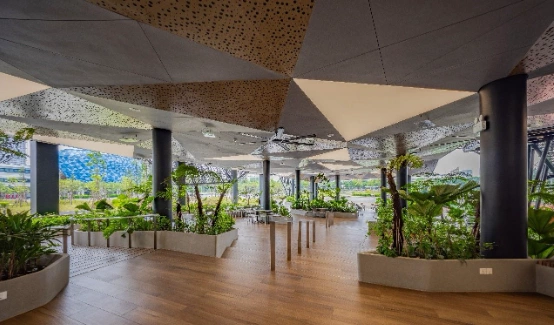
The British University Vietnam (BUV) stands out as a rare pioneer in shaping a truly green university environment. In collaboration with ARDOR Green, BUV has incorporated green elements right from the design stage, including natural ventilation, high-efficiency air conditioning, sustainable materials, and passive architectural solutions.
The result? BUV has become the first and only university in Vietnam to earn the EDGE Advanced certification, achieving on-site energy savings of over 40%—an impressive figure for any green building project.
Teaching to Change Behavior, Not Just to Pass Exams
Infrastructure is just the hardware. What’s more valuable is the integration of sustainability thinking into academic programs, helping students understand their role in a world facing climate crises. Courses on ethics, responsible tourism, and green development provide not only knowledge but also nurture a sense of responsibility.
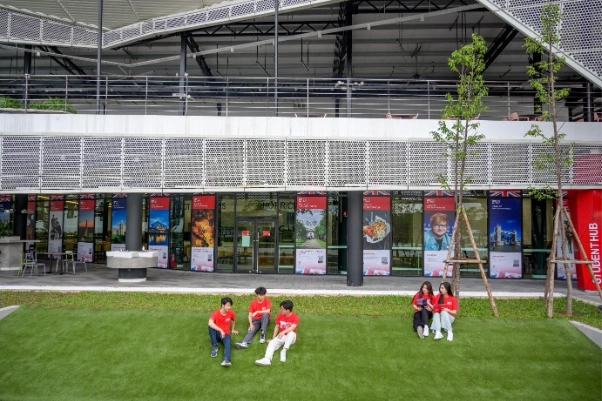
At BUV, students are also encouraged to participate in environmental activities and social skill development programs. In the near future, they will study under solar panels to be installed by 2026.
Today’s Education – The Starting Point for a Sustainable World
The green transition cannot rely solely on top-down policies. It must be seeded where each future citizen is shaped: in universities.
With pioneering models like BUV, we can hope for a generation of students who are not only professionally competent but also committed to preserving our planet—from small actions on campus to major life decisions in the real world.
Latest news

GRI standards now available in Vietnamese: What it means for ESG Reporting in Vietnam
On 14 September 2026, the Global Reporting Initiative (GRI) announced that the latest versions of its complete sustainability reporting Standards are now available in Vietnamese. The release covers the revised Universal Standards, all current Sector Standards and the latest Topic Standards, including GRI 101: Biodiversity 2024, GRI 102: Climate Change 2025 and GRI 103: Energy 2025. [1] GRI first made its Standards available in Vietnamese in 2017. The 2026 update brings Vietnamese-language users up to date with the current modular system and gives companies across the country direct access to the same reporting framework used internationally to identify, manage and disclose impacts on the economy, environment and people. [1] GRI is also expanding engagement in Vietnam through training, technical guidance and knowledge-sharing, with particular attention to small and medium-sized enterprises (SMEs). According to GRI, these programs are intended to help organizations assess sector-specific impacts, strengthen value-chain resilience and respond to disclosure expectations from international markets and sustainable finance providers. [1]

Green Finance in Vietnam: Buildings Seeking Capital Must Start with Data
On 18 September 2026, the Vietnam International Financial Centre in Da Nang (VIFC-DN) identified green finance and the carbon market as priority areas for development. The announcement was not accompanied by a specific lending product, but it sent a clear signal about the direction of green capital in the years ahead: projects will increasingly need to demonstrate environmental performance through data that can be measured, reviewed and independently verified. For developers, industrial asset owners, FDI companies and building operators, the key question is no longer simply “Is this building green?” The more important questions are: “What data proves that it is green, who verifies that data, and will the data continue to be maintained after financing has been disbursed?”

Green industrial parks: A key factor in attracting the next generation of FDI
As international investment increasingly prioritises sustainable development, green industrial parks are emerging as a new competitive benchmark for the market. The attractiveness of an industrial park is no longer determined solely by land availability or rental rates. Today, competitiveness depends increasingly on infrastructure quality, operational capability, ESG performance and the ability to create an efficient and sustainable production ecosystem for investors.


Circular economy under scarcity pressure: Is resource autonomy the solution?
Amid increasing resource scarcity and escalating geopolitical instability, the concept of resource autonomy is emerging as a strategic priority. This article examines how resource autonomy not only complements—but may even surpass—the circular economy as a framework for enabling industrial systems to adapt to the future.

Advancing Green Building Materials for Sustainable Development
As pressure to reduce carbon emissions continues to intensify, green building materials are becoming an increasingly important direction for Vietnam’s construction industry. Green material solutions can help improve energy efficiency, reduce operating costs and minimise environmental impacts. At the same time, the use of environmentally responsible materials can support projects seeking green building certifications such as LEED, LOTUS and EDGE. For businesses, this is becoming an important factor in strengthening competitiveness and supporting long-term sustainable growth.
Build Green, Build with ARDOR Green

