

Green Finance in Vietnam: Buildings Seeking Capital Must Start with Data
Share:
On 18 September 2026, the Vietnam International Financial Centre in Da Nang (VIFC-DN) identified green finance and the carbon market as priority areas for development. The announcement was not accompanied by a specific lending product, but it sent a clear signal about the direction of green capital in the years ahead: projects will increasingly need to demonstrate environmental performance through data that can be measured, reviewed and independently verified.
For developers, industrial asset owners, FDI companies and building operators, the key question is no longer simply “Is this building green?” The more important questions are: “What data proves that it is green, who verifies that data, and will the data continue to be maintained after financing has been disbursed?”
What is shaping green finance in Vietnam today?
Four key policy and market instruments are currently shaping the connection between buildings, environmental requirements, greenhouse gas inventories and access to green capital.
| Instrument | Status | Role | Relevance to buildings |
|
Decision 21/2025/QD-TTg – Green Taxonomy |
Effective from 22 August 2025 |
Defines 45 sectors and activities across seven groups that may be considered for green credit and green bonds; construction includes two project categories |
Relevant where a project seeks recognition under the Green Taxonomy |
|
Decree 119/2025/ND-CP amending Decree 06/2022 |
Effective from 1 August 2025 |
Regulates mandatory greenhouse gas inventories for facilities covered by the applicable list |
Relevant where the asset or facility falls within the mandatory inventory scope |
|
Decree 29/2026/ND-CP – Carbon Market |
Issued on 3 March 2026 |
Establishes the pilot phase for emissions allowance trading on the Hanoi Stock Exchange |
Not yet directly applicable; buildings are not currently within the pilot allowance allocation group |
|
VIFC-DN strategic priorities |
Announced on 18 September 2026 |
Identifies green finance, ESG, carbon markets and sustainable financial products as priority areas |
Does not yet create an immediate financing product, but indicates the direction of future market design |
The common thread across these instruments is that access to green finance increasingly depends on evidence.
Energy consumption, emissions, water efficiency and the proportion of materials meeting sustainability criteria only become meaningful when the underlying data is collected consistently and can be reviewed and verified.
What has VIFC-DN announced?
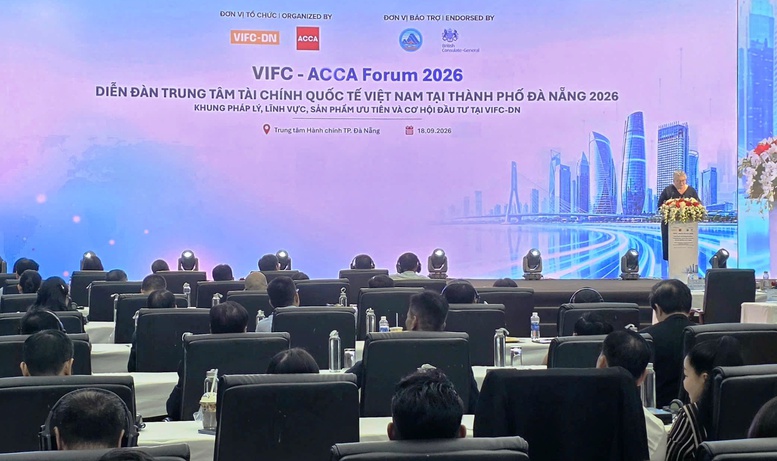
Figure 1: Vietnam International Financial Centre Forum in Da Nang 2026, focusing on the legal framework, priority sectors and emerging investment opportunities. Photo: chinhphu.vn/NA
At the forum held on 18 September 2026 by the Vietnam International Financial Centre in Da Nang (VIFC-DN) in cooperation with the Association of Chartered Certified Accountants (ACCA), discussions focused on the legal framework, priority sectors and investment opportunities.
Green finance, ESG, carbon credit markets and sustainable financial products were identified as important areas for future development.
Da Nang’s leadership described the centre as a platform connecting international capital with investment opportunities in Vietnam.
Representatives of VIFC-DN highlighted four key conditions for this development:
- A transparent legal environment
- Strong coordination between public authorities and businesses
- Accessibility for banks and investors
- Robust digital infrastructure
A memorandum of understanding between VIFC-DN and ACCA was also signed during the event.
These developments reflect a stage of institutional and market-infrastructure development rather than the immediate rollout of a specific green lending product.
However, this is precisely the stage at which projects should begin standardising their data. Future financial products are likely to rely on the same logic of classification, evidence and verification already being applied to green credit today.
When is a project considered green under Vietnamese law?
Decision 21/2025/QD-TTg, signed on 4 July 2025 and effective from 22 August 2025, establishes Vietnam’s legally recognised Green Taxonomy. A project must satisfy two groups of requirements:
The first relates to environmental documentation: Projects must have the relevant decision approving the appraisal of their environmental impact assessment, an environmental licence or environmental registration, except where an exemption applies under existing regulations.
The second relates to sector-specific eligibility criteria: A project must fall within one of the 45 sectors and activities listed in Appendix I and meet the corresponding environmental criteria. For the construction sector, these criteria focus on areas such as environmentally responsible materials, energy-efficient design and operations, water and waste management, and appropriate monitoring systems aligned with recognised international standards such as ISO 14001.
Green project verification: Corporate must take responsibility for the data
Project owners may request confirmation from the competent state authority or engage an independent assessment organisation that meets recognised standards such as TCVN ISO/IEC 17029:2020, ISO/IEC 17029:2019 or ISAE 3000. The verification body is legally responsible for the conclusions it issues.
At its core, ISO/IEC 17029 concerns the validation and verification of claims. In practical terms, this means that an organisation puts its name and professional responsibility behind the data and statements disclosed by a project. If a project cannot provide the underlying data, the verifier has no sufficient basis on which to issue a confirmation.
Can green building certification replace confirmation under the Green Taxonomy?
The practical value of green building certification lies in the evidence base it creates.
A project pursuing LEED, LOTUS or EDGE typically already has structured technical documentation such as:
- Energy models
- Testing and commissioning records
- Material documentation
- As-built drawings
- Operational performance data
Because this information is already organised in a reviewable format, it can make subsequent verification faster and reduce the cost of collecting documentation again. However, green building certification does not replace the two legal requirements described above. In other words, certification can strengthen the quality and readiness of a project’s evidence, but it does not automatically constitute legal confirmation under Vietnam’s Green Taxonomy.
Latest news

GRI standards now available in Vietnamese: What it means for ESG Reporting in Vietnam
On 14 September 2026, the Global Reporting Initiative (GRI) announced that the latest versions of its complete sustainability reporting Standards are now available in Vietnamese. The release covers the revised Universal Standards, all current Sector Standards and the latest Topic Standards, including GRI 101: Biodiversity 2024, GRI 102: Climate Change 2025 and GRI 103: Energy 2025. [1] GRI first made its Standards available in Vietnamese in 2017. The 2026 update brings Vietnamese-language users up to date with the current modular system and gives companies across the country direct access to the same reporting framework used internationally to identify, manage and disclose impacts on the economy, environment and people. [1] GRI is also expanding engagement in Vietnam through training, technical guidance and knowledge-sharing, with particular attention to small and medium-sized enterprises (SMEs). According to GRI, these programs are intended to help organizations assess sector-specific impacts, strengthen value-chain resilience and respond to disclosure expectations from international markets and sustainable finance providers. [1]

Green industrial parks: A key factor in attracting the next generation of FDI
As international investment increasingly prioritises sustainable development, green industrial parks are emerging as a new competitive benchmark for the market. The attractiveness of an industrial park is no longer determined solely by land availability or rental rates. Today, competitiveness depends increasingly on infrastructure quality, operational capability, ESG performance and the ability to create an efficient and sustainable production ecosystem for investors.


Circular economy under scarcity pressure: Is resource autonomy the solution?
Amid increasing resource scarcity and escalating geopolitical instability, the concept of resource autonomy is emerging as a strategic priority. This article examines how resource autonomy not only complements—but may even surpass—the circular economy as a framework for enabling industrial systems to adapt to the future.

Advancing Green Building Materials for Sustainable Development
As pressure to reduce carbon emissions continues to intensify, green building materials are becoming an increasingly important direction for Vietnam’s construction industry. Green material solutions can help improve energy efficiency, reduce operating costs and minimise environmental impacts. At the same time, the use of environmentally responsible materials can support projects seeking green building certifications such as LEED, LOTUS and EDGE. For businesses, this is becoming an important factor in strengthening competitiveness and supporting long-term sustainable growth.

Green construction is no longer a choice - It is becoming the cost of staying in business for Vietnamese companies
Vietnam’s construction industry is entering a period of transformation on an unprecedented scale. In the past, “green construction” was often treated as a branding trend or a marketing advantage. Today, ESG requirements, emissions audits and low-carbon standards are increasingly becoming prerequisites for companies seeking to participate in global supply chains. At the seminar “Science, Technology and Sustainable Development”, organised by the Ho Chi Minh City Construction and Building Materials Association (SACA), experts shared a common message: the construction industry no longer has much time to “prepare” for the green transition - action needs to start now.
Build Green, Build with ARDOR Green

