

Khu công nghiệp sinh thái: khoảng cách giữa tiêu chí Nghị định 35 và chứng nhận khách thuê FDI yêu cầu
Share:
Demand is returning while supply is tightening. Yet few industrial park management teams can answer a simple question with hard numbers: of the space currently available for lease, how many square metres come with certification documentation that a multinational corporation can incorporate into its emissions reporting?
The term “green industrial park” does not answer that question, because it often combines three very different things: a legal definition, a marketing label, and a technical certification framework.
1. What does Decree 35/2022/ND-CP require?
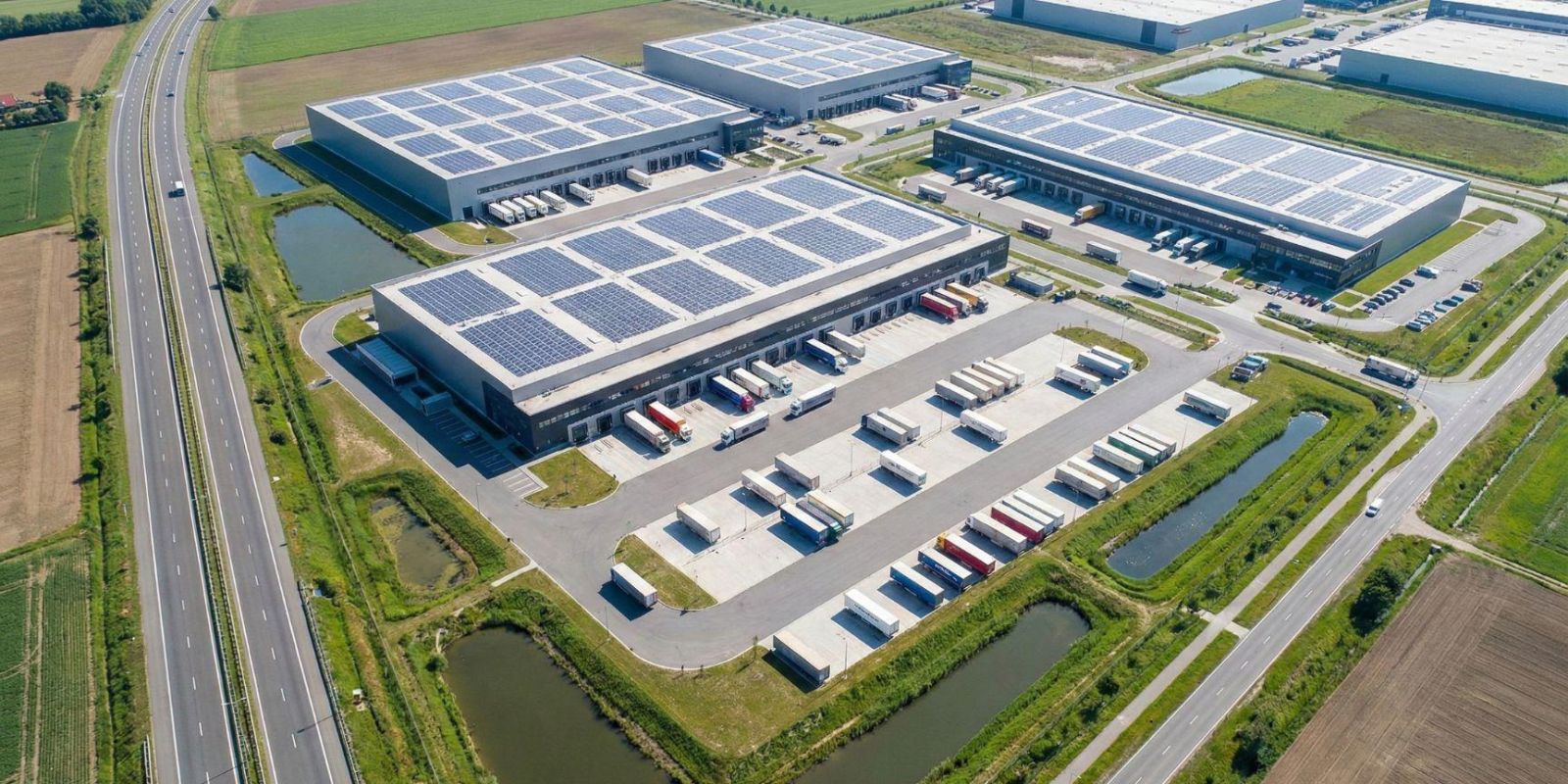
The official legal term is eco-industrial park, as defined under Decree 35/2022/ND-CP on the management of industrial parks and economic zones, issued on 28 May 2022 and effective from 15 July 2022. Circular 05/2025/TT-BKHDT, issued on 24 January 2025 and effective from 15 March 2025, provides detailed guidance on the registration and certification process.
Clause 1, Article 37 sets out the criteria for an eco-industrial park. The main requirements include:
| Criteria | Requirement |
|
Regulatory compliance |
Compliance with regulations on investment, enterprises, construction, land, environmental protection and labour for the three years preceding the certification application |
|
Resource efficiency |
At least 20% of enterprises within the industrial park must implement resource efficiency and cleaner production (RECP) measures and demonstrate measurable savings |
|
Industrial symbiosis |
At least one industrial symbiosis initiative must be implemented; participating enterprises must apply production and environmental management systems in accordance with ISO standards |
|
Infrastructure and spatial planning |
At least 25% of the industrial park’s land area must be allocated to greenery, transport infrastructure, technical infrastructure and shared social infrastructure |
|
Services and monitoring |
Essential infrastructure services must be adequately provided, with mechanisms in place to coordinate and monitor inputs and outputs |
|
Worker welfare |
Solutions must be provided for worker housing, service facilities and public amenities |
Two operational points are particularly important. Circular 05/2025 allows newly established industrial parks to commit to meeting the Article 37 criteria within eight years from the date of establishment, provided that a clear implementation roadmap is submitted.
Conversely, where an eco-industrial park certificate has been revoked, the industrial park may only apply for certification again after five years.
This is a park-level recognition mechanism, based largely on the collective performance and practices of enterprises within the park. It does not assess the technical performance of each individual factory building.
2. FDI tenants assess a different checklist

The sustainability team of a multinational corporation does not primarily review the park-level eco-industrial park recognition dossier. It reviews the technical documentation of the specific building being leased, because that data must ultimately be consolidated into the parent company’s emissions and sustainability reporting.
Typical requirements include:
- Building-level certification - LEED, LOTUS or EDGE, including certification level and issue date (1)
- Electricity source mix and access to Direct Power Purchase Agreements (DPPA) - factors that directly affect Scope 2 greenhouse gas emissions (2)
- Electricity and water consumption efficiency per unit of output for manufacturing facilities; for data centres, this includes PUE (Power Usage Effectiveness) and WUE (Water Usage Effectiveness) (3) (4)
- Water reuse systems, supported by actual measured performance rather than design capacity alone (5)
- Emissions documentation for CBAM purposes - with an important limitation: CBAM entered its definitive phase on 1 January 2026, but currently applies to iron and steel, cement, fertilisers, aluminium, hydrogen and electricity. Electronics, currently a major tenant segment in Northern Vietnam, are not yet within its scope (6)
None of these items appears directly in Article 37.
Industrial symbiosis - arguably one of the most demanding requirements under Article 37 - also rarely appears as a primary item in a prospective tenant’s technical due-diligence checklist.
3. Three layers of certification - and they do not replace one another
|
Decree 35/2022 – Eco-Industrial Park |
LOTUS IP (VGBC) |
LEED v4.1 Cities and Communities: Plan and Design |
|
|
Nature |
Government recognition mechanism linked to incentives under Article 39 |
Market-based certification system developed specifically for industrial parks in Vietnam |
International certification system for cities, communities, economic zones and large-scale developments |
|
Issuing authority |
Competent state authority |
Vietnam Green Building Council (VGBC), a member of WorldGBC |
USGBC / GBCI |
|
Level of application |
Entire industrial park |
Whole industrial park, including tenant buildings where individual criteria do not specify a narrower scope |
Entire defined project boundary |
|
Certification levels |
Pass / fail |
Certified · Silver · Gold · Platinum |
Certified 40–49 · Silver 50–59 · Gold 60–79 · Platinum 80+ out of 110 points |
|
Industrial symbiosis |
Mandatory - at least one linkage |
Included as one of four additional categories beyond the LOTUS building framework |
No dedicated industrial symbiosis category |
|
Technical weighting |
No weighted scoring system |
Builds on LOTUS NC v4 and expands into shared infrastructure management, park-wide monitoring and regional climate resilience |
Energy and emissions 28%, transport and land use 16%, natural systems and ecology 12%, water 11% |
|
Link with building certification |
Not specifically addressed |
Applies to technical infrastructure, developer-owned buildings or the entire development depending on the criterion |
Includes a credit based on the proportion of floor area within the boundary that is registered for or certified under LEED, EDGE or an equivalent system |
|
Validity |
If revoked, re-certification can only be sought after five years |
Three years, followed by recertification |
Subject to the applicable USGBC certification cycle |
|
Status in Vietnam |
In force since 2022 |
Pilot programme - registration opened on 10 May 2026, with Pilot certifications expected in Q2 2027 |
Established internationally, but not yet widely adopted for industrial parks in Vietnam |
First, LEED Cities includes a credit based on the proportion of floor area within the project boundary that has been registered for or certified under a building certification system. This is perhaps the clearest evidence that the two levels - park and building - do not replace each other. They stack. The greater the share of certified factories within a park, the stronger the park-level certification profile can become.
Second, industrial symbiosis is an area where the Vietnamese framework places particular emphasis. Decree 35 requires at least one industrial symbiosis linkage, while LOTUS IP incorporates industrial symbiosis within its expanded criteria. LEED Cities, by contrast, does not contain a dedicated category for it.
An industrial park that performs strongly on industrial symbiosis may therefore see that effort recognised more explicitly under Vietnam-focused frameworks than under an international urban-scale system.
4. Where is certified industrial floor area concentrated?
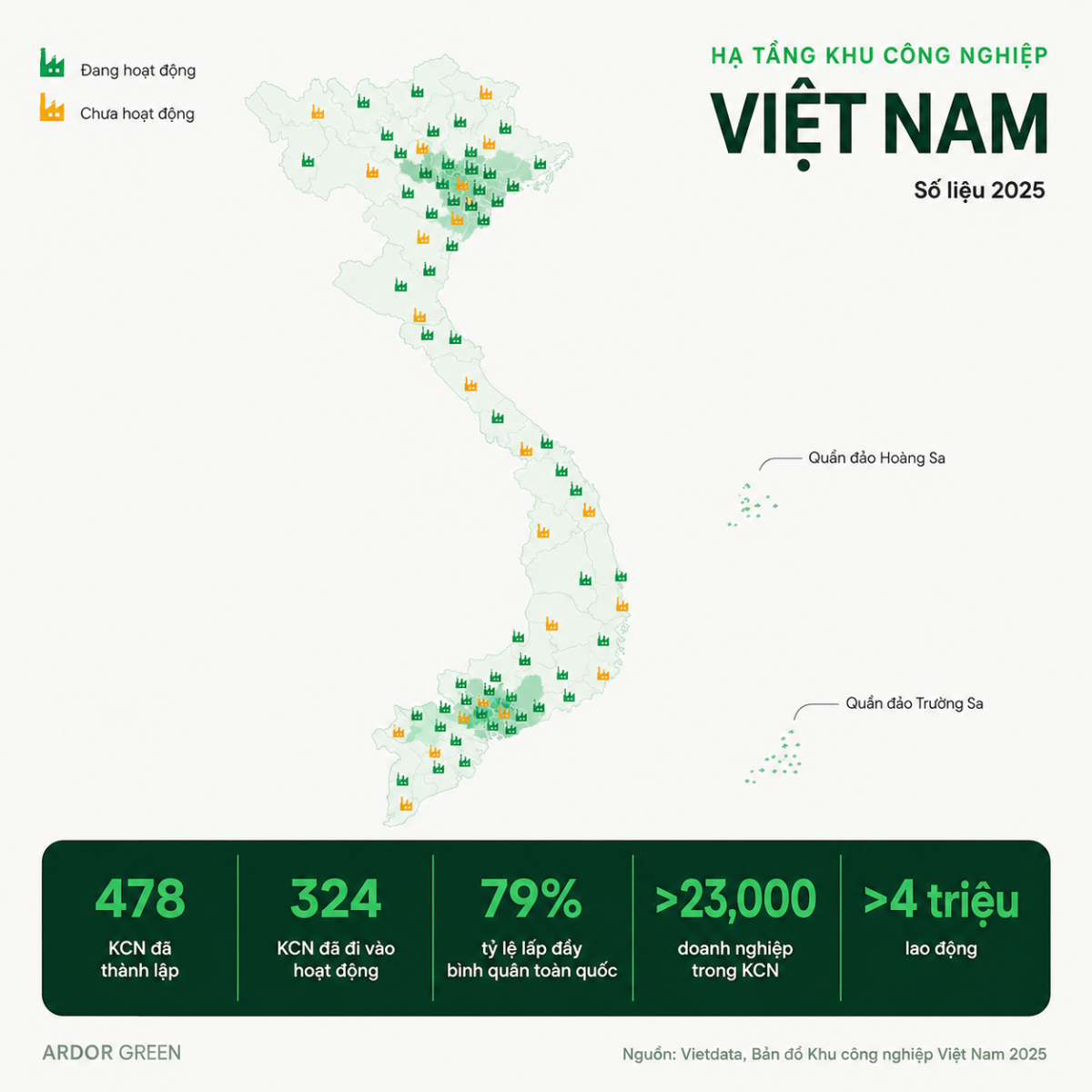
Vietnam has more than 450 established industrial parks, while the number operating under an eco-industrial park model remains relatively limited. At the individual building level, the available data is clearer. Within ARDOR Green’s project portfolio, the industrial segment - including factories, warehouses, logistics parks, industrial parks and office buildings located within industrial developments - comprises 41 projects with more than 2.8 million m² of gross floor area, representing 29.6% of ARDOR Green’s total project portfolio.
|
Province / City |
Share |
|
Bắc Ninh |
25.5% |
|
Hải Phòng |
18.7% |
|
Ho Chi Minh City |
8.9% |
|
Long An |
8.3% |
|
Vĩnh Phúc |
7.4% |
|
Hưng Yên |
5.7% |
|
Bắc Giang |
5.5% |
|
Đồng Nai |
5.1% |
|
10 other localities |
14.9% |
Source: ARDOR Green project data, updated July 2026. These figures represent ARDOR Green’s consulting portfolio and should not be interpreted as market-wide data.
Within this portfolio, geographic concentration is significant: Northern Vietnam accounts for 72.7% of total GFA, while Bắc Ninh, Hải Phòng, Hải Dương and Hưng Yên alone account for 53.4%. These locations overlap closely with the group of Tier 1 industrial markets in Northern Vietnam identified by CBRE, where industrial land absorption has been among the strongest in the country.
Certification preferences are equally concentrated.
Within ARDOR Green’s industrial portfolio, LEED accounts for 83.7% of GFA, compared with 13.0% for EDGE and 3.2% for LOTUS.
These figures reflect the composition of ARDOR Green’s client base and should not be interpreted as certification market share across Vietnam. A large proportion of the industrial developers in this portfolio are foreign-invested companies that bring the technical standards and certification requirements of their parent organisations into Vietnam.
For industrial park developers and management teams, the practical implication is clear: park-level infrastructure needs to support the technical requirements of LEED-certified buildings, because an individual factory owner cannot compensate for deficiencies that originate at masterplan or shared-infrastructure level.
5. Five areas industrial parks should prepare for
- Electricity documentation - disclose the electricity source mix, remaining rooftop solar capacity and the expected pathway for DPPA participation. Prospective tenants need numbers, not qualitative commitments.
- Lot-level consumption data - metering infrastructure should be installed from the outset. Retrofitting a reliable monitoring system later is significantly more difficult.
- Masterplanning that allows individual buildings to earn certification credits - if the industrial park masterplan does not meet certain requirements, individual factory owners may have no practical way to address them within their own plots.
- Transport connectivity for workers - relevant both to worker welfare requirements under Article 37 and to credits within systems such as LEED and LOTUS.
- An English-language technical due-diligence package ready for review - one of the most effective ways to shorten a prospective tenant’s decision-making cycle, yet something relatively few industrial parks currently have prepared.
6. Frequently asked questions
What is the difference between an eco-industrial park and a green industrial park?
“Eco-industrial park” is the legal term used under Decree 35/2022, with defined criteria and a formal recognition process.
“Green industrial park” is a market term and does not, by itself, carry a legally binding definition.
When communicating with regulators, the legal terminology should be used. For international tenants, however, what often matters most in technical due diligence is the certification and performance documentation of the specific building they intend to occupy.
If an industrial park has been recognised as an eco-industrial park, do individual factories inside it still need their own certification?
Yes.
Eco-industrial park recognition applies at the park level, while LEED, LOTUS and EDGE can be applied at the individual building level.
For many multinational companies, sustainability and real-estate teams still require documentation relating specifically to the building being leased or occupied.
Can ready-built factories be certified?
Yes.
A substantial share of ARDOR Green’s industrial portfolio consists of ready-built factories and warehouses. For this development model, registering an entire cluster of buildings from the basic design stage is typically far more efficient than pursuing certification building by building after completion.
Competition for green FDI is often discussed at the provincial level.
But the leasing decision ultimately takes place at the level of the individual factory - and it is made on the basis of very specific technical documentation.
The gap between these two levels is where many industrial parks may be losing prospective tenants without fully understanding why.
ARDOR Green provides LEED, LOTUS, EDGE and Green Mark certification consultancy for industrial projects across Vietnam, with 41 projects representing more than 2.8 million m² of gross floor area.
Discuss your project with ARDOR Green today.
Latest news

GRI standards now available in Vietnamese: What it means for ESG Reporting in Vietnam
On 14 September 2026, the Global Reporting Initiative (GRI) announced that the latest versions of its complete sustainability reporting Standards are now available in Vietnamese. The release covers the revised Universal Standards, all current Sector Standards and the latest Topic Standards, including GRI 101: Biodiversity 2024, GRI 102: Climate Change 2025 and GRI 103: Energy 2025. [1] GRI first made its Standards available in Vietnamese in 2017. The 2026 update brings Vietnamese-language users up to date with the current modular system and gives companies across the country direct access to the same reporting framework used internationally to identify, manage and disclose impacts on the economy, environment and people. [1] GRI is also expanding engagement in Vietnam through training, technical guidance and knowledge-sharing, with particular attention to small and medium-sized enterprises (SMEs). According to GRI, these programs are intended to help organizations assess sector-specific impacts, strengthen value-chain resilience and respond to disclosure expectations from international markets and sustainable finance providers. [1]

Green Finance in Vietnam: Buildings Seeking Capital Must Start with Data
On 18 September 2026, the Vietnam International Financial Centre in Da Nang (VIFC-DN) identified green finance and the carbon market as priority areas for development. The announcement was not accompanied by a specific lending product, but it sent a clear signal about the direction of green capital in the years ahead: projects will increasingly need to demonstrate environmental performance through data that can be measured, reviewed and independently verified. For developers, industrial asset owners, FDI companies and building operators, the key question is no longer simply “Is this building green?” The more important questions are: “What data proves that it is green, who verifies that data, and will the data continue to be maintained after financing has been disbursed?”

Green industrial parks: A key factor in attracting the next generation of FDI
As international investment increasingly prioritises sustainable development, green industrial parks are emerging as a new competitive benchmark for the market. The attractiveness of an industrial park is no longer determined solely by land availability or rental rates. Today, competitiveness depends increasingly on infrastructure quality, operational capability, ESG performance and the ability to create an efficient and sustainable production ecosystem for investors.

Circular economy under scarcity pressure: Is resource autonomy the solution?
Amid increasing resource scarcity and escalating geopolitical instability, the concept of resource autonomy is emerging as a strategic priority. This article examines how resource autonomy not only complements—but may even surpass—the circular economy as a framework for enabling industrial systems to adapt to the future.

Advancing Green Building Materials for Sustainable Development
As pressure to reduce carbon emissions continues to intensify, green building materials are becoming an increasingly important direction for Vietnam’s construction industry. Green material solutions can help improve energy efficiency, reduce operating costs and minimise environmental impacts. At the same time, the use of environmentally responsible materials can support projects seeking green building certifications such as LEED, LOTUS and EDGE. For businesses, this is becoming an important factor in strengthening competitiveness and supporting long-term sustainable growth.

Green construction is no longer a choice - It is becoming the cost of staying in business for Vietnamese companies
Vietnam’s construction industry is entering a period of transformation on an unprecedented scale. In the past, “green construction” was often treated as a branding trend or a marketing advantage. Today, ESG requirements, emissions audits and low-carbon standards are increasingly becoming prerequisites for companies seeking to participate in global supply chains. At the seminar “Science, Technology and Sustainable Development”, organised by the Ho Chi Minh City Construction and Building Materials Association (SACA), experts shared a common message: the construction industry no longer has much time to “prepare” for the green transition - action needs to start now.
Build Green, Build with ARDOR Green

