

Urban Cooling — A Sustainable Pathway Integrated into Infrastructure Planning
Share:
Vietnam is increasingly demonstrating strong commitment to reducing emissions and responding to climate change by placing “sustainable cooling” at the center of urban planning and development.
Viet Nam is increasingly demonstrating a strong commitment to reducing emissions and responding to climate change by placing “sustainable cooling” at the center of urban planning and development. This approach not only mitigates urban heat effects but also promotes energy savings, protects public health, and reduces greenhouse gas emissions.

Integrating Sustainable Cooling into Urban Planning
Under an international cooperation program, the Department of Climate Change (DCC), UNEP, and the Global Green Growth Institute (GGGI) have jointly implemented the initiative “Sustainable Urban Cooling in Vietnamese Cities.”
In pilot cities such as Can Tho, Tam Ky (Quang Nam), and Dong Hoi (Quang Binh), the parties have supported the development of Urban Cooling Action Plans (UCAPs) tailored to local conditions.
.png)
Figure 1. Methodology for developing an urban cooling model for Can Tho City
This marks an important step in making cooling — not merely a comfort need — an essential component of urban planning and design, ranging from building architecture to green spaces, water surfaces, and urban transportation systems.
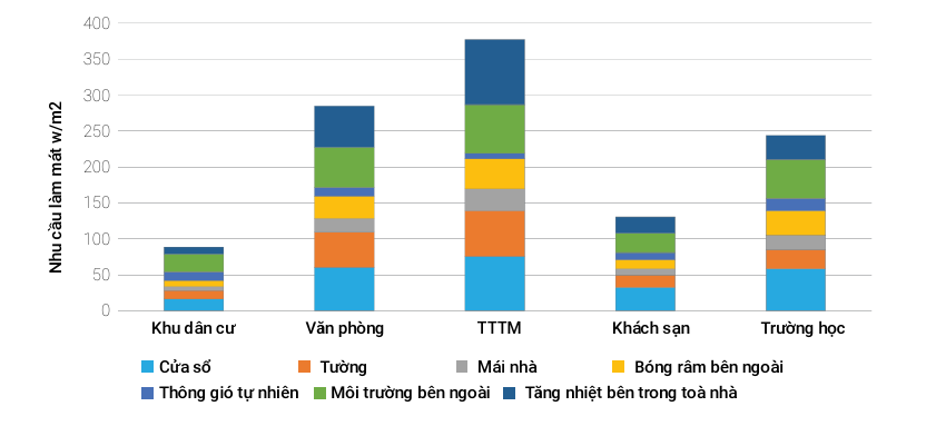
Figure 2. Components of building cooling loads under extreme heat conditions
Prioritizing Passive Cooling: Greenery, Ventilation, and Smart Design
A core objective is to prioritize passive cooling solutions — such as increasing green cover, expanding shaded areas, using reflective materials, enabling natural ventilation, and integrating water elements — instead of relying solely on air conditioning. This strategy reduces the urban heat island effect, lowers electricity demand, and thereby indirectly cuts greenhouse gas emissions.
Pilot Implementation in Can Tho and Tam Ky — From Planning to Action
-
In Can Tho: The UCAP provides a comprehensive assessment of urban heat conditions, cooling needs, and appropriate interventions to strengthen heat resilience and climate adaptability.
-
In Tam Ky: Following microclimate surveys and analyses of temperature, humidity, building density, and land use, the city finalized its urban cooling plan with the goal of developing a greener, more sustainable, and heat-resilient urban area.
Experiences from these cities are considered model cases for replication in other fast-growing urban areas with high population and construction density.
The Role of Cities in Reducing Emissions from Cooling
Experts affirm that cities are critical nodes in efforts to reduce emissions from cooling activities. Cities concentrate dense populations and buildings — making them highly vulnerable to heat — while also having the ability to systematically manage planning, land use, and building codes to reduce artificial cooling demand.
A well-planned urban system — with greenery, water bodies, efficient ventilation pathways, and controlled construction density — can create urban microclimates that are cooler within and around buildings. In this way, each building or neighborhood becomes part of a natural cooling network, easing pressure on energy-intensive mechanical cooling systems.
Moreover, according to international data, the sustainable cooling market in developing countries — including Viet Nam — is expanding rapidly, creating significant opportunities for environmentally friendly investments and attracting private financing to support green growth.
Towards Cooler Cities — Lower Emissions — Sustainable Development
Integrating sustainable cooling into urban infrastructure planning is no longer optional; it is becoming a fundamental requirement for modern Vietnamese cities. Pilot efforts in Can Tho and Tam Ky — supported by UNEP and GGGI — demonstrate that the model is scalable nationwide.
.jpg)
Figure 3. The Department of Climate Change (Ministry of Agriculture and Rural Development) collaborates with UNEP and GGGI to review activities on effective and climate-friendly urban cooling in Viet Nam.
If widely implemented, these efforts would help reduce energy-based cooling demand, cut emissions, protect public health, and enhance quality of life — guiding Vietnamese cities toward a greener, more sustainable, and climate-friendly development pathway.
Passive Cooling Solutions for Cities: Short-, Medium-, and Long-Term Roadmaps
Recommended passive urban cooling solutions are structured into three phases:
-
Short term: Maintain and increase existing green spaces; expand shaded streets; preserve natural water bodies; and engage communities in creating green areas. At the same time, integrate cool roofs, green buildings, and material standards into planning and construction practices.
-
Medium term: Improve access to large green spaces, plant more shade trees in residential areas, meet WHO recommendations for minimum green space per capita, and expand water-based cooling solutions. Adjusting the proportion of heat-absorbing surfaces (concrete, asphalt) and developing ventilation corridors also play key roles.
-
Long term: Prioritize water surfaces and wind corridors in new urban masterplans; adopt heat-resistant design principles such as “porous cities” to enhance ventilation and reduce heat absorption. Public procurement should prioritize cool materials and thermal-control solutions. In parallel, expanding green transportation, reducing asphalt coverage, and transitioning to permeable materials will help cities better adapt to extreme heat.
Latest news

Scope 3 Emissions - Điểm mù lớn nhất của bất động sản bền vững
Mỗi sáng, hàng nghìn người di chuyển đến tòa nhà của bạn bằng xe máy xăng, ô tô cá nhân hoặc taxi công nghệ. Mỗi chiều, họ lại rời đi theo cách tương tự. Chu trình đó lặp lại hàng trăm ngày mỗi năm - và trong suốt thời gian đó, một lượng phát thải carbon khổng lồ đang được tạo ra bên ngoài phạm vi vận hành trực tiếp của tòa nhà. Đây là “điểm mù Scope 3” của bất động sản.

Circular Economy Under Scarcity Pressure: Is Resource Autonomy the Solution?
Amid increasing resource scarcity and escalating geopolitical instability, the concept of resource autonomy is emerging as a strategic priority. This article examines how resource autonomy not only complements—but may even surpass—the circular economy as a framework for enabling industrial systems to adapt to the future.


ARDOR Green named Vietnam’s Top 3 LEED® Proven Providers™ by GBCI
What this means for our clients: A more efficient LEED review timeline, with approvals completed significantly faster than the standard review process. Direct and enhanced engagement with the GBCI review team, enabling complex issues to be reviewed and resolved through focused, one-on-one discussions. Independent recognition of ARDOR Green’ established expertise in LEED project administration, reflecting the firm’s high standards in design quality and documentation.

Unlocking Multi-Credit Synergies through Integrative Design in LEED v4
The realization of benefits associated with LEED starts with a transformation of the design process itself. Rather than treating credits as separate components on a checklist, an Integrative Process encourages project teams to identify synergies and interrelationships across multiple categories. By conducting early research and analysis during the "discovery" phase, teams can implement specific building features that "stack" points, achieving high levels of performance and cost-effectiveness.

Re-shaping the Construction Industry: When Emissions, Technology, and Data Become the New Market Standards
In recent years, green finance has often been cited as the key that enables Vietnamese enterprises to access international markets. However, the broader picture of the construction industry reveals a far deeper transformation: the world is not merely changing how capital is allocated, but is fundamentally restructuring the entire industry toward low emissions, advanced technology, and data transparency.
Build Green, Build with ARDOR Green

