

Green Buildings in Vietnam: Data Analysis and Development Trends for 2025
Share:
The shift is evident across Asia
Internationally, the shift to sustainable construction is even more evident. In the Asia-Pacific region, APAC is a global leader in renewable energy – accounting for around 60% of new capacity in recent years. JLL research shows that by 2030, 75% of APAC office real estate leaders expect at least half of their portfolios to be powered by renewable energy, and 40% of businesses see on-site renewable power as “essential” in the near future.. (1)
ASIAN BUSINESSES ENGAGED IN PROVIDING INFORMATION ON SCIENTIFIC TARGETS INITIATIVES
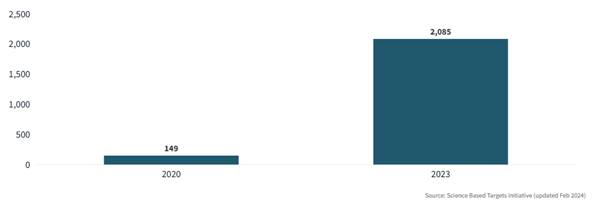
Source: Science Based Targets Initiative (updated Feb 2024)
Globally, McKinsey forecasts that the Asian “green” market will be worth around US$4–5 trillion by 2030(2), indicating huge investment potential in the sustainable sector. At the same time, international energy agencies have stressed the need to improve energy efficiency in buildings. The IEA points out that, if following a zero-carbon scenario (NZE), the average energy consumption per square meter of buildings must be reduced by around 35% by 2030 compared to 2022.(3).
Vietnam reaches out to become a major economy in Asia
In Vietnam, indicators show that the green building market is booming. According to the latest report, by the end of 2024, Vietnam will have about 560 green certified buildings (EDGE, LEED, LOTUS, etc.), exceeding the target set for 2030 many times.(4)(5).
GREEN CERTIFICATION CONSULTING ACTIVITIES IN VIETNAM
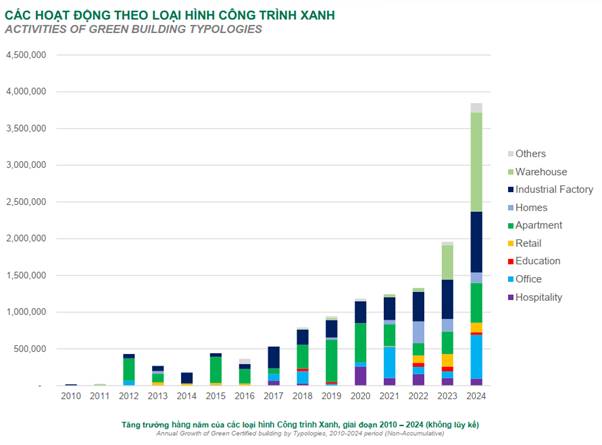
Source: VnEconomy (updated Feb 2025)
Notably, more than half of the newly certified buildings are industrial buildings (factories), reflecting the urgent need for green certification in export industrial zones. The analysis also shows that the Vietnamese market mainly uses EDGE (42%) and LEED (39%) systems for green projects. (6).
The Vietnamese government is currently promoting preferential policies to encourage green building development: tax reductions, land rent incentives, and subsidies for energy-saving technologies. Along with that, foreign direct investment (FDI) flows into Vietnam's real estate are increasing, with more than 6.3 billion USD in 2024 mainly flowing into green industrial parks and expected to continue to increase in the coming years.(7).
Research from ARDOR Green's practical EDGE projects
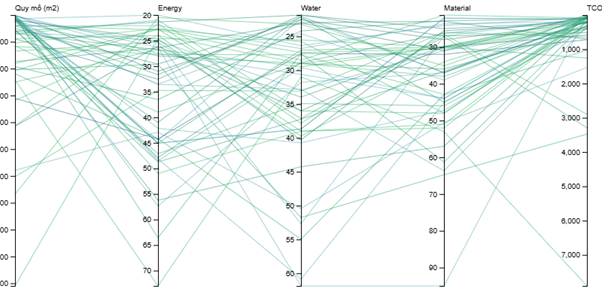
PARALLEL COORDINATES CHART OF ARDOR GREEN'S EDGE PROJECTS
Source: EDGE App (updated July 2025)
From ARDOR Green's practical projects implemented under EDGE certification, the parallel coordinate chart shows that environmental performance trends depend not only on scale, but more on design quality, technology choice and sustainable operation orientation of each type of construction:
Apartments: Some of these buildings are as small as 50,000–80,000 m² but achieve CO₂ savings comparable to large factories. This shows that when designed efficiently (e.g. with natural ventilation, good insulation, use of renewable energy), residential buildings can also achieve high environmental performance.
Mixed Use: Some medium-sized projects achieve high CO₂ savings through an optimal mix of energy and material use.
It is not always the case that large scale saves a lot of CO₂. Optimum design and building type greatly influence environmental performance.
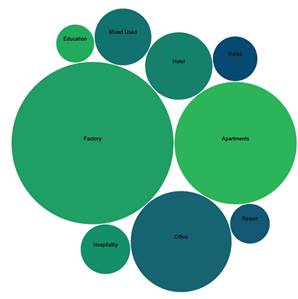
TCO2 SAVINGS ALLOCATION CHART COMPARED TO TYPES OF PROJECTS CONSULTED/DESIGNED BY ARDOR GREEN
Source: EDGE App (updated July 2025)
Education: Although a small proportion of projects, some educational buildings achieve relatively high CO₂ savings relative to their size. This can be attributed to the thorough application of EDGE standards, the use of natural lighting and water-efficient systems – which are easier to integrate into schools than commercial buildings.
Hospitality: Some curves show that hotels achieve relatively good CO₂ savings despite their small size. This can be attributed to investments in efficient HVAC technology and high service standards coupled with sustainability standards (e.g. international green hotels).
Buildings with high operating costs (e.g. hotels, schools) have a strong incentive to optimize energy efficiency – which increases environmental performance regardless of size.
Recommendations for investors and project owners:
Integrate green design and technology from the start: From the pre-feasibility stage, priority should be given to energy-saving, water-saving and material-saving solutions (e.g. using recycled materials, efficient lighting/cooling systems, planning to take advantage of natural light). According to analysis, green buildings can reduce CO₂ emissions by about 50% compared to traditional buildings.(8), although initial investment costs increase by about 5–25%. However, effective emission reduction will reduce long-term operating costs and increase asset value. (9). Investors should use specialized energy and material simulation software, as well as apply renewable technologies (solar power, rainwater harvesting, etc.) to achieve optimal efficiency.
Take advantage of preferential policies and attract investment: Investors should proactively exploit government incentive policies (tax reduction, land lease incentives, interest rate support) for green technology.(10). At the same time, it is important to note that international capital is pouring into green projects in Vietnam. For example, in 2024, more than 6.3 billion USD of FDI in real estate will focus on green industrial parks.(11). It shows that construction projects aiming for low emissions and high ESG standards will easily attract strategic investors and foreign capital.
Emphasizing long-term benefits and ESG values: Demonstrating a clear commitment to sustainability (publishing emission reduction targets, using renewable energy) will respond to market and customer trends, as more and more businesses and individuals prioritize “green” buildings and are willing to pay more for environmentally friendly projects.(12)(13).
About ARDOR Green:
ARDOR Green, established in 2015, is one of the leading and pioneering consultants in sustainable design and green buildings in Vietnam. The company specializes in providing consulting and design services according to international standards such as LEED, LOTUS, EDGE, WELL, Fitwel and GRESB, with a commitment to optimizing investment efficiency and project development for customers and partners.
Latest news

GRI standards now available in Vietnamese: What it means for ESG Reporting in Vietnam
On 14 September 2026, the Global Reporting Initiative (GRI) announced that the latest versions of its complete sustainability reporting Standards are now available in Vietnamese. The release covers the revised Universal Standards, all current Sector Standards and the latest Topic Standards, including GRI 101: Biodiversity 2024, GRI 102: Climate Change 2025 and GRI 103: Energy 2025. [1] GRI first made its Standards available in Vietnamese in 2017. The 2026 update brings Vietnamese-language users up to date with the current modular system and gives companies across the country direct access to the same reporting framework used internationally to identify, manage and disclose impacts on the economy, environment and people. [1] GRI is also expanding engagement in Vietnam through training, technical guidance and knowledge-sharing, with particular attention to small and medium-sized enterprises (SMEs). According to GRI, these programs are intended to help organizations assess sector-specific impacts, strengthen value-chain resilience and respond to disclosure expectations from international markets and sustainable finance providers. [1]

Green Finance in Vietnam: Buildings Seeking Capital Must Start with Data
On 18 September 2026, the Vietnam International Financial Centre in Da Nang (VIFC-DN) identified green finance and the carbon market as priority areas for development. The announcement was not accompanied by a specific lending product, but it sent a clear signal about the direction of green capital in the years ahead: projects will increasingly need to demonstrate environmental performance through data that can be measured, reviewed and independently verified. For developers, industrial asset owners, FDI companies and building operators, the key question is no longer simply “Is this building green?” The more important questions are: “What data proves that it is green, who verifies that data, and will the data continue to be maintained after financing has been disbursed?”

Green industrial parks: A key factor in attracting the next generation of FDI
As international investment increasingly prioritises sustainable development, green industrial parks are emerging as a new competitive benchmark for the market. The attractiveness of an industrial park is no longer determined solely by land availability or rental rates. Today, competitiveness depends increasingly on infrastructure quality, operational capability, ESG performance and the ability to create an efficient and sustainable production ecosystem for investors.


Circular economy under scarcity pressure: Is resource autonomy the solution?
Amid increasing resource scarcity and escalating geopolitical instability, the concept of resource autonomy is emerging as a strategic priority. This article examines how resource autonomy not only complements—but may even surpass—the circular economy as a framework for enabling industrial systems to adapt to the future.

Advancing Green Building Materials for Sustainable Development
As pressure to reduce carbon emissions continues to intensify, green building materials are becoming an increasingly important direction for Vietnam’s construction industry. Green material solutions can help improve energy efficiency, reduce operating costs and minimise environmental impacts. At the same time, the use of environmentally responsible materials can support projects seeking green building certifications such as LEED, LOTUS and EDGE. For businesses, this is becoming an important factor in strengthening competitiveness and supporting long-term sustainable growth.
Build Green, Build with ARDOR Green

